
Continued from page 1
Once you have decided where to go, your conduct on the slope will determine your safety. If you follow the rules and keep thinking, you have a much lower risk of triggering an avalanche. If you do not, you could turn a slope that professionals would regard as offering a safe passage into a very unsafe place to be.
Go one at a time on exposed parts of the mountain, do this wherever slopes above and/or below are steep enough to avalanche. This is one of the golden rules of off-piste/avalanche risk management. The weight of one person is much less likely to trigger a slide than that of two or more people. And if the worst happens, only one of you will get caught and the rest of the group are able to organise a rescue.
When we go on a low angle slope and there are no steep slopes above us, we don’t go one at a time. There is no reason to. However, once we get into areas where there are 25° slopes, we know that there will be steeper and shallower slopes around us. Then we make sure that we only ever expose one skier at a time to any risk.
Only ever stop at islands of safety. These are places where you are protected from potential risks, such as under a rock, on a ridge and not below a loaded slope (nothing dangerous above).
Ridges are good places to go to whenever you have the slightest doubt. Riding along a ridge is generally a pretty safe bet as long as you don’t ride out onto a cornice above a big drop-off.
A ridge doesn’t have to be a classic knife-edge. It can be a rounded area, often referred to as a shoulder. The key point for avalanche safety is that it shouldn’t have a significant slope above you that could release and sweep you away.
Avoid convexities. This is where the slope goes from flat to steep abruptly. A lot of slabs fracture here due to a higher amount of traction stress in these areas.
To observe this, try bending a Mars bar, the chocolate layer cracks at the convexity (where it bends) because that’s where most of the stress is concentrated. That is a lot like the snowpack on a slope where there are convexities.
Keep your tracks together. The merits of this may not be proven scientifically, but if you follow next to the track of the person who went in front of you and they didn’t set off an avalanche then the chances of you triggering an avalanche are much reduced.
Keeping your tracks close together is also good manners. It preserves fresh lines for other people. It is also a courtesy to other skiers mixed in with respect for the mountain.
Terrain traps may exist below you. Remember this is where you could end up if something is let loose above you. Will it take you into a hole, a ravine or a lake? Will it take you over a cliff?
Terrain traps are anything below you that could make the consequences of being swept away even worse. Terrain traps can transform a small avalanche into a fatal one.
Don’t trigger avalanches on other people, this is really bad form and you’ll go to jail if you kill them.
Always have escape routes in mind. If you are a really good skier, you can sometimes ski out in front of the avalanche and then get out to the side. But recognise it’s very, very difficult to get out of a moving avalanche. Have a plan, but remember most of us will not succeed.
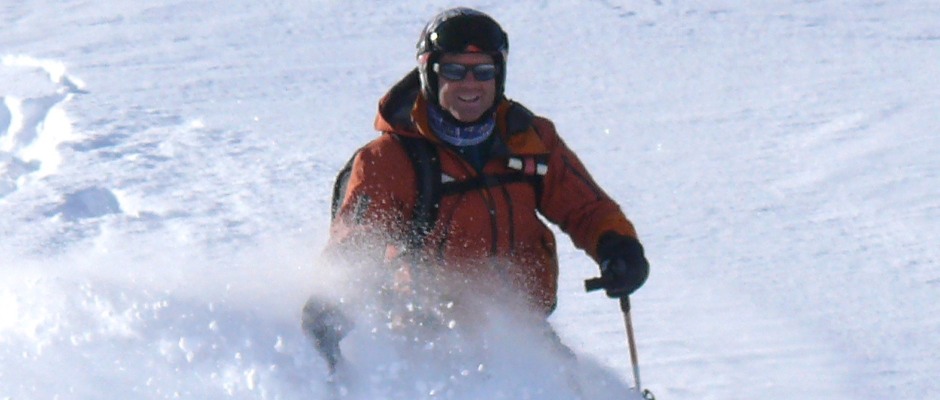
"Follow next to the track of the person who went in front of you..."

Start thinking: you can be prepared with all the right equipment, but if you’re not thinking about what you’re doing then, you are an accident waiting to happen.
Start thinking early: by talking with your friends about where you are thinking of going; get an idea of the ability level of the people in the group; find out if they are willing to play the game the way you want to; what is the group tolerance for risk?
Is there someone in the group who is going to be pushed beyond their limit, then fall and cause you to spend time in places that might be a danger to the rest of the group?
Manage your group size: Three to five people is a good number for a group of friends skiing together.
Watch the human factor. Most accidents are predictable. Often mistakes or bad judgement were responsible and bad judgement comes about due to the human factor.
Examples of the human factor are: passion, "if we don’t get to that slope now, it’ll be all skied out"; stubbornness, "we’re going to ride that slope no matter what today"; ignorance, "what? I had no idea".
Know how to use your equipment (beeper shovel probe): If you are still alive when the avalanche stops you have 15 minutes to live. If your friends have this equipment and know how to use it, then they should be able to find you in less than 15 minutes.
For free
1. Make sure you are registered on our website and subscribed to the HAT ezine. This ensures you will receive weekly updates in the season. Here we will share some insights about what is going on and what you should think about.
2. Be inquisitive, discuss these ideas with your friends, and ask for advice from the piste patrol, ski instructors and mountain guides. They will be happy to share what they know (maybe they will not tell you where they will find the best snow, but they will offer advice to help you stay safe).
3. Contribute to and ask questions in the HAT Forum.
4. Watch part 1 of Ride Hard ! Ride Safe.
Invest and learn with HAT
Join the HAT club as a premium member. This costs £30 a season you will get the following
Invest and learn
If you want to get more out of your off-piste experiences, then this will pay ample rewards. With time and experience you will gain confidence to explore the off-piste without paying for a guide and without taking unnecessary risks. There are courses and programmes run in many resorts.
At HAT we believe in making the knowledge accessible and easy to apply. We are practical people. We think this makes us different. However, you do it, be safe and have fun.

"If you’re not thinking about what you’re doing then, you are an accident waiting to happen..."
Written by Henry Schniewind from Henry's Avalanche Talks.